Vietnam’s stock market capitalization increased 1.9 times after 5 years.
22-01-2026


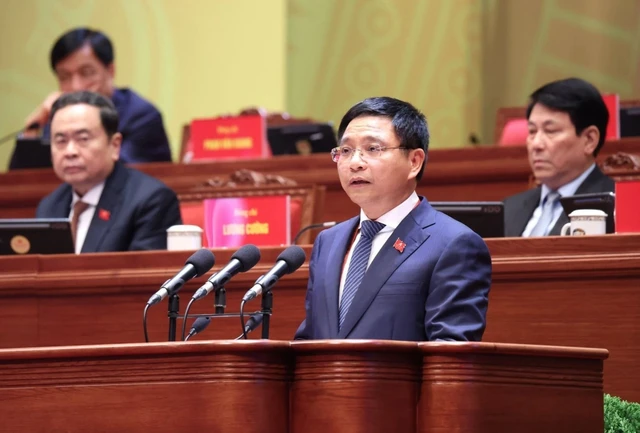
Presenting a paper on improving the institutional framework for mobilizing and utilizing financial resources to meet development requirements at the 14th Party Congress, Minister of Finance Nguyen Van Thang stated that the stock market capitalization has increased 1.9 times after 5 years.
On the afternoon of January 21st, continuing the discussion on the documents of the 14th National Congress of the Party, on behalf of the Party Committee of the Ministry of Finance, Central Committee member, Party Secretary, and Minister of Finance Nguyen Van Thang presented a paper on “Improving the institutional and legal framework for mobilizing and utilizing financial resources to meet the requirements of rapid and sustainable national development,” to further clarify strategic breakthrough solutions in improving the institutional framework to unleash all resources to realize the aspiration for national development in the new period.
Institutional motivation
According to Minister Nguyen Van Thang, in the past period, the Ministry of Finance has submitted to the Politburo for promulgation Resolution No. 68-NQ/TW on the development of the private economy, Resolution No. 79-NQ/TW on the development of the state economy, and has submitted and promulgated within its authority 929 legal documents, including 65 Laws and Resolutions of the National Assembly to remove bottlenecks, meet new development requirements, and enhance the competitiveness of the economy, focusing on three main areas:
Firstly, we must create a favorable investment and business environment, unleash all social resources, and improve the efficiency of capital utilization through fundamental and comprehensive amendments to laws on investment, state-owned enterprise management, and planning; minimize business conditions; promote decentralization and delegation of power; empower localities and businesses with autonomy; and ensure that businesses are allowed to do anything that is not prohibited by law. We must reform and simplify administrative procedures, modernize management practices to improve the efficiency of state management, reduce time and costs, and create maximum convenience for citizens and businesses in resolving long-standing stalled projects. We must also build a legal framework linked to new economic models such as free trade zones and new-generation industrial parks.
Secondly, effectively mobilizing and utilizing national financial resources: Advising on the improvement of the tax legal system towards simplicity, modernity, and conformity with international practices; shifting the mindset from “management” to “service,” linked with comprehensive digital transformation and the application of artificial intelligence (AI). Through this, the largest amount of resources ever mobilized for the state budget has been effectively utilized; simultaneously, maximum exemptions, reductions, deferrals, and postponements of various taxes and fees have been implemented to support the recovery and development of businesses during and after the COVID-19 pandemic, helping to nurture revenue sources and orient the development of priority sectors for restructuring the economy, innovating the growth model, and striving to achieve a digital economy of at least 30% of GDP by 2030 as stipulated in Resolution 57 of the Politburo.
Thirdly, developing the capital market and creating a framework for new economic models, proactively building a synchronized legal framework linked to the development trends of the times. New economic models such as: international financial centers, developing the stock market, piloting the cryptocurrency market, free trade zones, and new-generation industrial parks with investment and tax incentives aim to attract high-quality foreign investment while enhancing the internal capacity and competitiveness of the economy for rapid and sustainable development linked to digital and green transformation. Establishing a controlled testing mechanism for new business models, ensuring safe and transparent development. Under the leadership of the Party, the involvement of the entire political system from the central to local levels, along with the support of the people and the business community, the financial and budgetary institutions have contributed to the country achieving the successful results as presented in the report to the Congress.
Notably, the registered capital of enterprises increased by 37.6% compared to 2020; state budget revenue for the entire period is estimated at nearly 9.9 million billion VND, exceeding the target and 1.4 times higher than the previous term. Total public investment reached approximately 3.4 million billion VND, an increase of nearly 55% compared to the previous term. The stock market was upgraded, and market capitalization increased 1.9 times compared to 2020. An international financial center and new-generation free trade zones were established and put into operation.
Three bottlenecks
Besides the achievements, with a spirit of “self-reflection and self-correction,” the Party Committee of the Ministry of Finance seriously acknowledges that there are still some “bottlenecks” that need to be further improved in the coming time.
Firstly, how can laws on finance and budget keep pace with the practical demands of the scientific and technological revolution?
Secondly, policy implementation capacity is uneven, some issues are slow to be resolved, and the efficiency of capital utilization is not high.
Thirdly, the size of the capital market is not yet commensurate with its true potential and has not truly become the main channel for mobilizing medium and long-term capital for the economy.
Five solutions
The period 2026-2030 is a time for Vietnam to accelerate its development, make breakthroughs, and enter a new era to realize its aspiration of becoming a developed, high-income country by 2045. The Party Committee of the Ministry of Finance highly agrees with the goals, vision, orientations, and key tasks for the 2026-2030 period outlined in the draft Resolution, especially the target of an average GDP growth rate of 10% or more per year to ensure sustainable development; GDP per capita reaching approximately US$8,500 by 2030; and total social investment averaging about 40% of GDP.
To realize these goals, the draft Resolution identifies the task of focusing on comprehensively and synchronously perfecting institutions, and developing the country rapidly and sustainably, with economic institutions as the central focus. This is a mandate for the Finance sector to continue innovating its thinking and methods, and to act more decisively in building and perfecting institutions to mobilize and utilize financial resources more effectively, meeting the requirements of rapid and sustainable national development, focusing on six groups of tasks.
The first solution is to advise on the issuance of all guiding documents, new laws, and resolutions passed by the National Assembly in the first quarter of 2026, in accordance with the General Secretary’s directive, in order to bring the Party’s breakthrough policies and guidelines into practice as quickly as possible.
Secondly, we must advise on the institutionalization and effective implementation of the Party’s resolutions on the development of economic sectors, realizing development aspirations into concrete actions and results, promoting the restructuring of governance and capital in state-owned enterprises, improving operational efficiency, especially in project investment to ensure leadership while maintaining financial efficiency. We must affirm and promote the leading role of the state economy, developing the private economy to truly become the most important driving force of the economy, supporting development, expanding markets for the collective economy and cooperatives, attracting and effectively utilizing foreign investment, thereby building and consolidating a solid foundation for development, capable of withstanding and adapting increasingly effectively to global and regional fluctuations, enhancing strategic autonomy and the overall strength of the country in the new era.
Thirdly, we must continue to refine and implement expansionary fiscal policy, focusing on key areas, coordinating closely and harmoniously with monetary policy and other policies to ensure high growth targets while guaranteeing national financial security and stability, and macroeconomic stability.
Continue restructuring, improve the efficiency of public investment, focus resources on breakthrough projects, transform the situation, thoroughly understand economic accounting principles in the selection and implementation of each project, and ensure that the whole country does not exceed 3,000 projects using central government budget funds in order to attract and guide investment resources from other economic sectors.
Fourth, develop a comprehensive, modern, and integrated stock market to become the primary channel for mobilizing medium and long-term capital for the economy, effectively attracting international investment funds. Continue to improve the legal framework for new economic models and financial products such as the knowledge economy, circular economy, carbon market, green bonds, and cryptocurrencies.
Fifthly, regularly review and comprehensively evaluate the effectiveness of issued policies to promptly improve them according to development requirements, thereby definitively resolving bottlenecks and effectively implementing long-term planning in a positive direction. Strengthen regional and sectoral linkages, apply and digitize the entire public service process in the financial sector, minimize administrative procedures and unreasonable business conditions, and ensure a transparent and healthy competitive environment to create momentum for development, forming growth poles, key economic regions, and new-generation special economic zones on par with the region and the world.
Sixth, continue to strengthen policy communication, dissemination, and enforcement of laws to bring policies into life, create consensus among the people and business community, closely link lawmaking and enforcement, and strengthen discipline in policy implementation.
cafef.vn
Market Life